
In the article Slovene Word-Sense Disambiguation and Novelty Detection with Dictionary Examples, published in Data & Knowledge Engineering, Prof. Dr. Marko Robnik-Šikonja and Assist. Prof. Dr. Tadej Škvorc address the problem of word sense disambiguation (WSD), which involves determining the correct meaning of a word with multiple possible senses based on its context. Modern approaches typically rely on machine learning models that require large amounts of manually annotated data for training, but such resources are not always available for many languages, including Slovenian.
One possible solution is the automatic generation of training data using large language models, provided that the generated data is of sufficient quality. Until now, no study had demonstrated whether language models could generate Slovenian-language data of adequate quality to support word sense disambiguation.
The authors conducted a thorough evaluation and showed that this approach is feasible. They compared different predictive models trained exclusively on manually annotated data with models trained on a combination of manually annotated and automatically generated data. The evaluation demonstrated that the generated data improves model performance.
The results suggest that a similar approach could be effective for many other tasks and languages where large manually annotated datasets are unavailable.
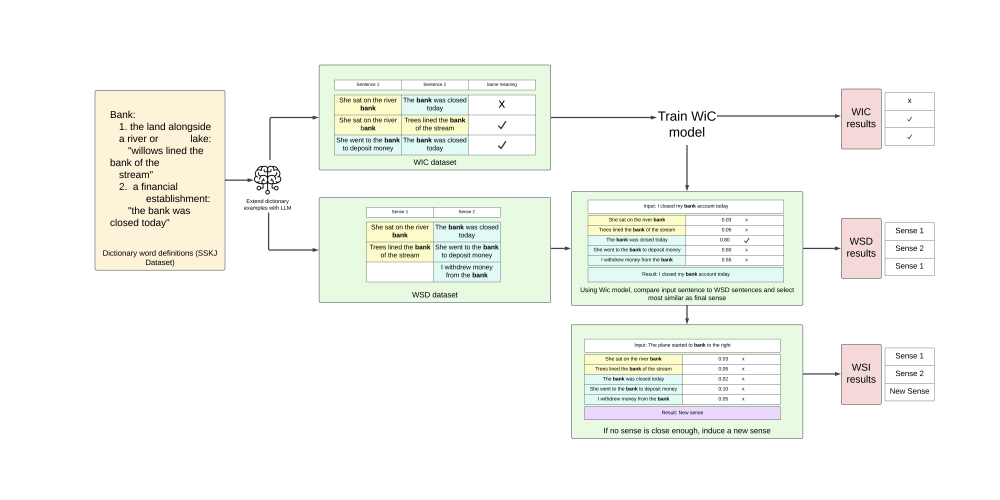
Figure: Overview of the complete methodology. Generated data are evaluated on three tasks: WiC (Word-in-Context), where the model predicts whether a word has the same meaning in two different contexts; WSD (Word Sense Disambiguation), where the model predicts the exact meaning of a word; and WSI (Word Sense Induction), where the model determines whether a word appears with a new, previously unseen meaning.
Read more: