
The rapid development and integration of digital technologies into everyday life has raised concerns about their impact on human cognitive abilities.
This topic is explored by Urška Žnidarič, Prof. Dr. Erik Štrumbelj, and Assist. Prof. Dr. Octavian Mihai Machidon in the article A Scoping Review of the Negative Effects of Digital Technology on Cognition, published in Computers in Human Behavior Reports. The authors focus on documented negative effects of digital technology use on cognition.
Evidence suggests that the nature of cognitive risks is changing. Research on older technologies mainly describes disruptions in the allocation of cognitive resources, while early findings related to artificial intelligence indicate a possible gradual weakening of higher cognitive functions. However, this remains a hypothesis that requires further investigation.
Negative effects are also often influenced by socioeconomic status and environmental factors, suggesting that cognitive decline is frequently not the result of technology itself, but rather of other activities being displaced by technology use.
The article also discusses the phenomenon of cognitive offloading, in which people increasingly delegate mental tasks such as remembering information, navigation, and problem-solving to digital technologies. The authors warn that excessive reliance on devices and online services may reduce the active use of cognitive abilities and, over time, contribute to a decline in cognitive reserve, which helps individuals maintain cognitive functioning despite aging or neurological changes. As a result, excessive use of digital technologies could become a risk factor for poorer physical health in the future.
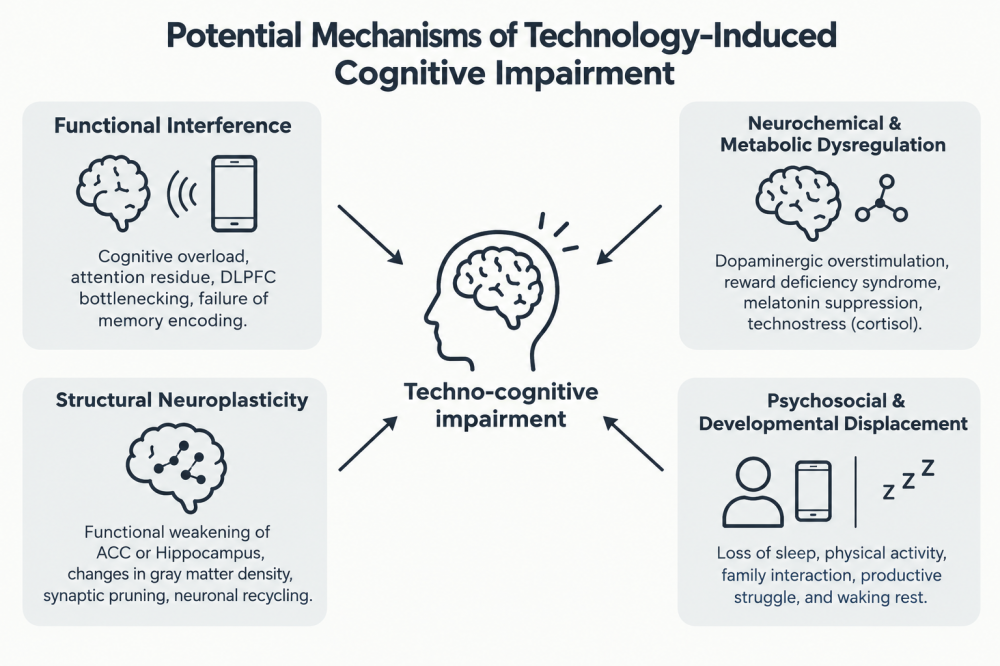
Figure 1: Potential impacts of digital technologies on brain functioning and cognitive processes.
Read more at: